Financial benefits of implementing BIM technology
02/26/2026
Building Information Modeling (BIM) has become a key tool in the investment process, enabling more accurate cost planning, improved coordination, and the elimination of design errors. Thanks to precise data derived from 3D models, investors gain greater control over budgets and project schedules. This is a solution that directly translates into savings and increased efficiency for any investment. Design in BIM and discover how it reduces investment costs and increases planning accuracy. Contact us to take advantage of these benefits in your project.
Share this article
Design in BIM!
Discover how BIM reduces development costs and enhances planning precision. Get in touch to bring these benefits to your project.
CONTACT
- Financial benefits of BIM models for investors
- What changes when we use BIM
- Without BIM
- What our clients value most in BIM
- What we gain with BIM
- BIM as a source of savings
- Does BIM reduce costs at the design stage?
- Where BIM delivers real financial benefits
- Summary
Financial benefits of implementing BIM technology in the project
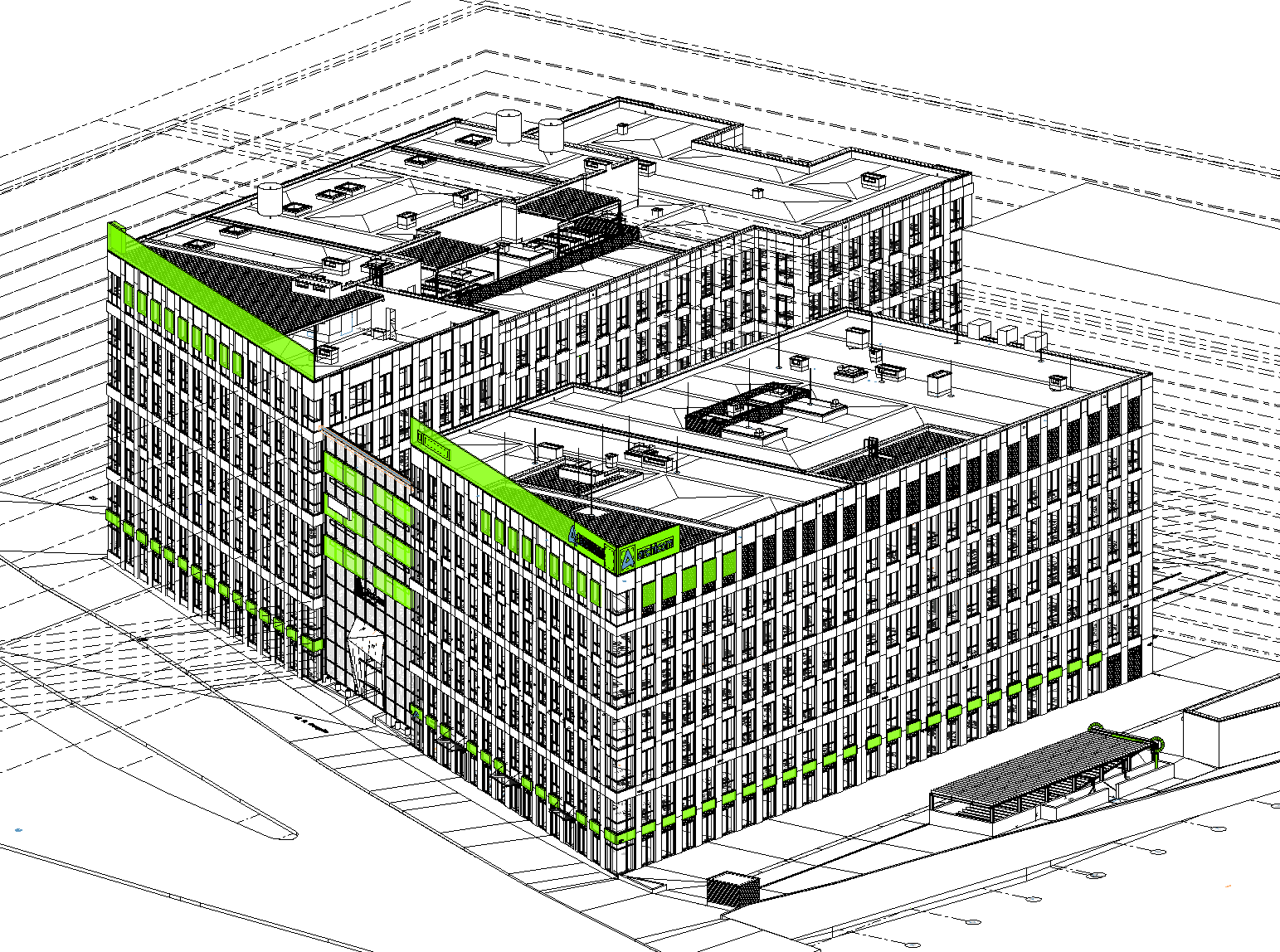
Implementing BIM, like the implementation of any technology in a process, aims to eliminate delays. This directly results in increased savings within the company budget. It should be emphasized, however, that this occurs only when the BIM methodology is applied correctly and appropriately to the type of project. Investors, general contractors, and designers each benefit differently from BIM implementation. Ultimately, however, all these benefits, based on working with a BIM model, largely translate into financial gains. A practical example is the City Forum office complex, where the use of a Revit model during the design phase enabled optimization of installation routes and structural solutions, eliminating the need for transfer beams. This made it possible to add an additional story compared to the original analyses. Furthermore, the introduction of repetitive, beamless floor layouts allowed both the general contractor and the investor to shorten construction time for structural and installation works, ultimately reducing the overall project schedule.
Naturally, for construction time to be shortened, the investor must be aware of the tangible benefits of using BIM in an investment and apply the BIM methodology consciously. If this awareness is lacking, decisions at the contracting stage regarding the project schedule will be based on previous non-BIM experience, which won’t translate into measurable financial benefits for investors. For this reason, at SRDK STUDIO we place strong emphasis on educating our clients about the practical value of BIM implementation and identifying the specific areas of planning and execution where measurable financial benefits can be achieved.
Financial benefits of BIM models for investors
One of the most important aspects of implementing BIM is the ability to work with defined three-dimensional object types embedded in a coordinated 3D model. At SRDK STUDIO, discussions about BIM begin as early as the contract signing stage. Together with you, we define what types of data can be extracted from the model and at which stages of the project, based on the information contained in our BIM models. This allows investors to plan budget milestones for their projects from the very beginning. In the early project phases, material quantity indicators derived from models carry a higher margin of error. However, as the design progresses and the modeling accuracy of individual building components increases, project accuracy improves and budget planning becomes more precise.
3D models enable us to deliver higher-quality documentation to our clients. By higher quality, we mean the elimination of errors through interdisciplinary coordination in 3D. In recent years, we have observed a significant decrease in construction site queries from our investors regarding clashes between disciplines. Today, the majority of our author’s supervision focuses on material substitutions or approvals for alternative construction technologies rather than resolving design conflicts. For us, this is clear evidence that BIM models effectively eliminate design-related causes of construction downtime and delays.
What changes when we use BIM
By using BIM software and supporting design tools, we model building information in a comprehensive manner. This means applying a holistic approach that covers all key aspects of building information modeling. In other words, we create a model that includes not only basic building elements such as walls, roofs or windows, but also additional data, including:
- technical parameters and material data,
- electrical, plumbing and HVAC installations,
- construction schedules,
- costs and project management,
- information related to building operation and maintenance.
Without BIM
Without BIM, achieving this level of data completeness at the design stage would be extremely difficult. It should be noted that the higher level of detail required in BIM does extend the time needed during the concept and building permit phases. This is because more time is invested in modeling detailed geometric and parametric information. On the other hand, this level of detail clearly supports faster decision-making and ensures better coordination. This approach helps limit the need for costly changes during the course of the project. By viewing the model in three dimensions, the client gains a clearer understanding of the consequences of their decisions and is able to make more informed, well-considered choices.
What our clients value most in BIM
One of the most highly valued aspects of BIM among our clients is the ability to generate precise cost and schedule data. Investors gain a competitive advantage through improved control over the project and reduced financial risk. Better control over the investment budget and risk mitigation make it possible to achieve stronger results in a shorter timeframe.
Implementing BIM in a project allows our clients to avoid unnecessary expenses. This is achieved through the integration of data from multiple areas, from design and construction through to facility management after completion. BIM also enables the anticipation of potential issues and their early resolution, which significantly reduces overall investment costs. In a traditional design process, such clashes might only be discovered at the construction stage.
What we gain with BIM
With BIM, clashes and conflicts are identified at the design stage. Engineers can reroute a ventilation duct or adjust its dimensions long before construction starts, eliminating issues that would otherwise result in delays, additional costs or on-site corrections.
BIM as a source of savings
At SRDK STUDIO, we encountered a situation that can be seen as clear proof that investors can directly profit from BIM, meaning that BIM can translate into revenue generation. In the case of the City Forum office building, our client informed us that a decisive factor in the sale of the property was the fact that the entire documentation had been prepared using BIM technology and remained complete and up to date throughout the implementation process. In a highly competitive office market, the quality, completeness, and reliability of documentation play a crucial role in the operational and commercial value of a building.
BIM technology contributes to savings primarily through the reduction of construction costs. At the same time, it fundamentally transforms the design and delivery process, becoming a key source of efficiency not only for investors, but also for contractors and designers. Through precise building information modeling, BIM provides solutions that reduce costs at every stage of project delivery. However, this doesn’t mean that BIM-based projects or the preparation of BIM models themselves are cheaper.
The use of BIM eliminates the need for multiple on-site corrections resulting from design errors, reducing time losses and financial risks for general contractors and investors, who are often charged for additional works in such situations. It also allows certain project stages to be shortened. In practice, however, the time saved is usually reinvested in analyzing a greater number of design variants, implementing additional client-driven changes during the collaboration process, or further parameterizing the 3D model.
Year by year, the parameterization of BIM models is becoming one of the most important values for investors implementing BIM within their organizations. The combination of BIM tools and supporting software enables effective data management, which is essential for sound business decision-making. Integrating data from multiple sources significantly streamlines the investment process, shortens project timelines, and reduces the risk of delays. Above all, it allows investors to base their decisions on current, reliable data.
As a result, BIM gives investors greater control and enables financially and strategically sound decisions to be made already at the design stage.
Does BIM reduce costs at the design stage?
The cost of BIM-based projects often raises strong emotions. In pilot projects, when clients invest time and money to “try out BIM”, the same question inevitably arises: why should BIM be more expensive?
At SRDK STUDIO, our answer is always the same.
1. If our task is to deliver correctly prepared 2D documentation, including full interdisciplinary coordination, the tools and methods we use internally are not charged separately to the client. They are part of our operational costs and are covered by our standard design fee. We gain a competitive advantage, especially in public procurement, where documentation accuracy and process transparency are crucial.
Offers prepared on the basis of BIM models are also financially more accurate and closer to real construction costs. BIM-based 3D models allow for detailed cost planning and control, significantly reducing the risk of budget overruns. Our clients repeatedly emphasize that this precision enables them to manage investment resources more effectively, lowering costs during construction and later operation. For private-capital investors, BIM usually forms part of a long-term strategy rather than a one-off experiment. Over time, it becomes a tool for building durable market competitiveness.
2. However, if a client expects the delivery of:
- 2D documentation,
- correctly modeled 3D models meeting specific modeling requirements, since the modeling method affects material quantity take-offs,
- 3D models containing parameters with specific names compliant with the investor’s internal standard,
- 3D models including additional parameters used during construction,
- 3D models including parameters related to the facility management phase at handover,
- information exchange via CDE platforms, which in large-scale projects may require assigning even one full-time position solely to handling comments, verifying document currency and ensuring that internally archived documentation remains up to date, since access to the CDE platform usually ends with the contract,
then these activities go beyond the standard project scope. They represent more than what is delivered within a non-BIM project and therefore can’t be included in a standard design fee.
What often surprises clients most is the modeling method itself. Requirements related to the graphical appearance of drawings have a direct impact on modeling time. Contemporary BIM software is highly advanced but achieving a specific visual or data-related outcome frequently requires detailed configuration of many model elements. A display method used to achieve one effect may be completely unsuitable for another. In pilot BIM projects, clients often assume that once something is modeled, only a few clicks are needed to generate everything else. This perception is likely influenced by marketing presentations based on simple examples. In reality, things are more complex, and it’s not uncommon that we need to change the modeling approach during the project to achieve a different required outcome.
Where BIM delivers real financial benefits
From a financial perspective, it’s important to remember that ordering a broader scope of services from the designer has a clear business rationale. The investor reduces time losses within their own team by transferring part of the workload to the design office. This approach makes sense provided that the investor has previously invested in developing the competencies of their team, so they can actually use the new tools.
A BIM model prepared specifically for cost calculations and aligned with the investor’s internal standards eliminates the need for manual quantity take-offs. Data flows directly from the 3D model into cost estimation software, allowing investors to generate multiple datasets and analytical combinations without loss of information.
This is particularly important when working with area schedules and similar analyses that support key business decisions. Time that was previously spent compiling tables based on 2D documentation is now used by investors for optimization analyses, and crucially, it takes less time than processing traditional 2D drawings. Our clients are already experiencing the benefits of precise building information modeling delivered by SRDK STUDIO. In subsequent projects, they are willing to invest more in BIM, because we deliver not only documentation, but also structured data that actively supports their business goals.
We even collaborate with investors who provide us with their own BIM component libraries. They value consistency across technical documentation and interior fit-out in all their developments. These are BIM-mature clients who understand how to use new technologies effectively and, crucially, how their own decisions influence design time and outcomes.
Summary
Our experience shows that BIM, understood as comprehensive building information modeling, not only transforms the design process but also significantly improves facility management during the operational phase.
Thanks to lossless data transfer from BIM models to facility management systems, investors eliminate the time losses typical of non-BIM projects, where data must be manually re-entered. This is why more and more investors are consciously choosing BIM and supporting software – not as a cost, but as a tool that increases efficiency, reduces risk and strengthens their position across the entire investment lifecycle.
Share this article