Poland Shelter Act 2026, key changes for developers
04/24/2026
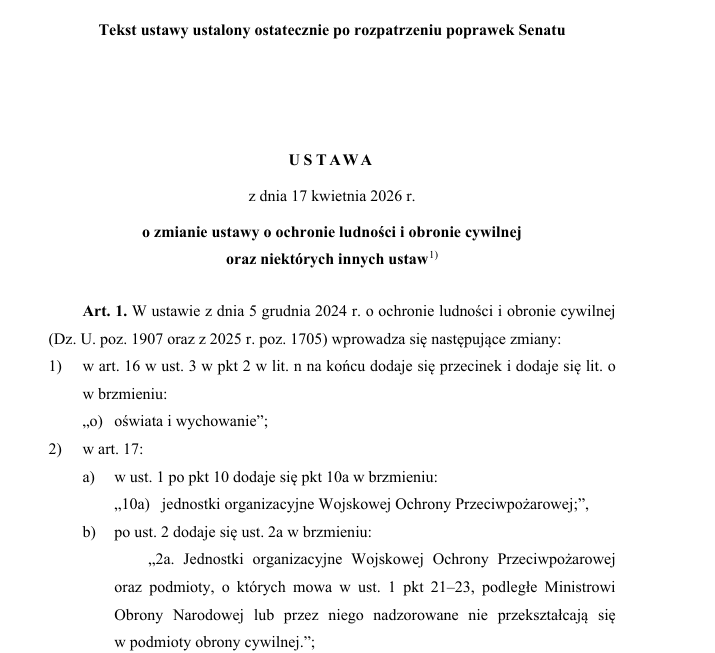
17.04.2026 - The Sejm adopted a major amendment to the Shelter Act, introducing new requirements for emergency shelter spaces, protective structures, and shelter points. For the first time, Poland has clear rules on ESS capacity calculations and a legal pathway for derogations. This is your complete guide to the key changes.
Share this article
Contact us!
New law, new headaches? Not necessarily. We've already mapped every clause of the 2026 Amendment - bring us your project and we'll handle the rest.
Contact
- New Category: shelter points
- Minimum capacity of emergency shelter spaces
- Maximum capacity of Emergency Shelter Spaces
- Derogations from technical requirements for emergency shelter spaces
- Exemption from the obligation to provide a protective structure
- Amendments to related legislation
- Summary
2026 Amendment to the Shelter Act, key changes
This article is intended for: architects, developers, property managers, civil protection authorities (municipalities and district councils), construction firms, and manufacturers of building and installation products, as well as any other organisations with an interest in civil protection and civil defence.
In recent days, the Sejm passed an amendment to the Shelter Act - formally, the Act Amending the Act on Civil Protection and Civil Defence and Certain Other Acts. This legislation introduces significant changes to the field of civil protection. In addition to organisational changes relating to civil protection and civil defence - covering, among other things, civil protection entities, training provisions, the organisation of the national secure communications system, and the structure of civil defence - the Act introduces a new category of civil protection facility.
The amendment to the Act on Civil Protection and Civil Defence, known as the Shelter Act, was adopted by the Sejm on 17 April 2026. It introduces a series of structural, organisational, and financial changes designed to align existing regulations with current security requirements. The provisions will enter into force in 2026 - specifically, 14 days after promulgation - with certain provisions taking effect retroactively from 1 January 2026. The Act will bring fundamental changes to building design requirements and to the organisation of civil protection.
New Category: shelter points
Alongside existing collective protection facilities — that is, protective structures (shelters and cover positions) and emergency shelter spaces — the Act introduces a new category: shelter points. These are defined as locations within buildings or other sites that are suitable for the temporary protection of people, providing a basic protective function against sudden severe weather events and the effects of conventional weapons, in particular fragmentation.
The new Article 91a of the Act on Civil Protection and Civil Defence specifies that shelter points include not only the newly defined locations suitable for the temporary protection of people in buildings or other sites, but also existing protective structures and emergency shelter spaces. The competent district (city) commander of the State Fire Service shall identify shelter points in:
- buildings in respect of which proceedings for recognition as a protective structure are ongoing;
- buildings or parts thereof that served as protective structures before the date of entry into force of this Act;
- planned locations for the organisation of emergency shelter spaces;
- buildings or other locations providing basic protection against severe weather events and the effects of conventional weapons, particularly fragmentation. The Act does not prescribe specific technical requirements for shelter points.
Minimum capacity of emergency shelter spaces
The enacted legislation addresses a significant gap in the regulation of emergency shelter space (ESS) sizing. Previously, neither the Act on Civil Protection and Civil Defence nor the implementing regulation on the conditions for organising emergency shelter spaces linked ESS capacity to the size of the basement level or the residential building in which the space was to be provided.
Under the amendment, ESS capacity must be not less than the number of persons calculated as follows:
In a public-use building:
- Usable floor area designated for public use ÷ 15 m² per person
In a multi-unit residential building:
- Total usable floor area of residential units ÷ 20 m² per person
In an underground car park:
- Twice the number of car parking spaces — unless the figures from (1) or (2) above yield a higher number.
Maximum capacity of Emergency Shelter Spaces
The Act also establishes a maximum ESS ( Emergency Shelter Spaces) capacity: no greater than the number of persons equal to 75% of the net floor area of the basement level or underground car park ÷ 1.5 m² per person.
These thresholds do not apply where:
- The number of residential units in a multi-unit residential building does not exceed 4;
- The usable floor area of a building designated for public use does not exceed 250 m²;
- The net floor area of the underground car park does not exceed 75 m².
Derogations from technical requirements for emergency shelter spaces
A major change introduced by this amendment is the possibility of obtaining a derogation from the technical requirements for emergency shelter spaces. Under new Article 92a, in justified cases these requirements may be met by means other than those prescribed by regulation, provided that the proposed alternative solutions deliver the protective functions necessary for the organisation of an emergency shelter space.
The competent regional governor, upon application by the developer or building owner — supported by a technical assessment — shall grant or refuse consent for the application of alternative solutions by means of an administrative ruling, following authorisation from the minister responsible for internal affairs.
A derogation may be granted in particular on grounds of site constraints, as set out in Article 94(4): where local site conditions — in particular the size of the building plot — prevent the organisation of an emergency shelter space of the capacity determined in accordance with the Act, the competent regional governor may, upon application by the developer or building owner, grant consent for the design and construction of a basement level or underground car park in a manner that enables the organisation of an emergency shelter space of reduced capacity.
Exemption from the obligation to provide a protective structure
Under the previous version of the Shelter Act, public-use buildings could not be constructed without provision for collective protection facilities. Protective structures were required wherever there was a demonstrable need to provide shelter capacity. Exemption was permitted only where persons in the building could be accommodated in a nearby protective structure, or where the structural and technical characteristics of an existing building made provision impossible. If no protective structure is planned for the basement levels of a public building, these levels must be designed and constructed to accommodate emergency shelter spaces. Under the new amendment, the mayor or the head of the local authority will be authorized to grant exemptions from the requirement to provide protective structures in public buildings via an administrative decision. A corresponding implementing regulation will follow, specifying the conditions under which this obligation is waived or where an exemption may be granted. Planning of protective structures
A further significant change is the introduction of a consultation procedure with the civil protection authority to determine the capacity and resistance category of the protective structure required in a proposed public-use building, or in a proposed underground structure located within the administrative boundaries of a city and intended for transport purposes — including road and rail — in particular deep-level metro structures, underground tram tunnels, and underground railway facilities.
Step 1 — notification
Under Article 95a, the developer notifies the mayor or head of the relevant local authority of the intention to carry out the development and submits documentation covering the location and characteristics of the project, including information on the extent of below-ground elements, the intended use of the building and its below-ground spaces, and the proposed approach to the provision of collective protection facilities.
Step 2 — determination of Competent Authority (14 days)
Within 14 days of receiving a complete notification, the mayor or head of the local authority liaises with the district administrator and the regional governor to determine which civil protection authority is competent to designate the proposed building as a protective structure.
Step 3 — ruling on Capacity and Resistance Category (45 days)
Within 45 days of the date of notification, the competent civil protection authority issues a ruling specifying the capacity and resistance category of the protective structure to be provided within the proposed building.
Step 4 — default Position (3 months)
Should the civil protection authority fail to issue a ruling within 3 months of receiving the notification, the developer may design the protective structure at any resistance category, with a minimum capacity of 30 persons.
If the competent civil protection authority has not specified a capacity or resistance category, for instance, by granting an exemption from the requirement to provide a protective structure, the provisions of Article 94 shall apply: the building must be designed to accommodate the setup of emergency shelter spaces.
Exceptions to the notification procedure
The notification procedure does not apply:
- where the developer is a local or regional authority — such as a municipality, district, or province — it may design protective structures with a resistance category and capacity tailored to the specific needs of that jurisdiction
- where the developer has obtained an exemption from the obligation to provide a protective structure in a public-use building.
Amendments to related legislation
Alongside the changes to the Act on Civil Protection and Civil Defence, amendments are being introduced to several related pieces of legislation, including:
- The Police Act
- The Border Guard Act
- The State Fire Service Act
- The Construction Law
- The State Protection Service Act
- The Act on the Conduct of Business in the Manufacture and Trade of Explosives, Weapons, Ammunition, and Products and Technology for Military or Police Use.
Summary
The current amendment to the Shelter Act addresses several important matters that had previously been unregulated — neither in the Act on Civil Protection and Civil Defence, nor in its implementing regulations, nor in any other statutory provision. From a construction industry perspective, the most significant amendments concern the detailed technical requirements for emergency shelter spaces—specifically, the introduction of a standardized methodology for calculating minimum and maximum capacity Equally important is the introduction of the possibility of obtaining a derogation from the technical requirements for emergency shelter spaces, particularly where local site conditions — in particular the size of the building plot — prevent the organisation of an emergency shelter space of the capacity prescribed by the Act.
Share this article